Ceilings get ignored until they do something alarming. A hairline crack that has been there for two years suddenly opens up, a faint ring appears after a storm, or a section starts to bow. In Northern Virginia the usual suspects are the same from Arlington out to Leesburg: humid summers and dry, heated winters that make framing move, attic condensate lines that drip in August, and a generation of houses built fast in the 1980s and 1990s where the ceiling was the last thing finished and the first thing rushed.
This guide covers what each symptom usually means, how urgent it is, and what the repair involves. If you would rather skip the reading, send us a photo and we will tell you which one you have.
What the ceiling is telling you
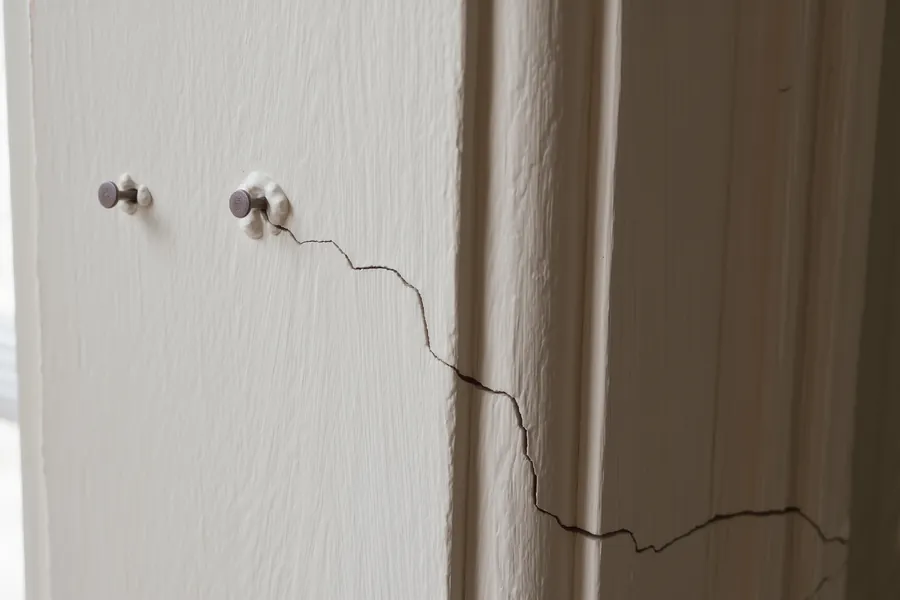
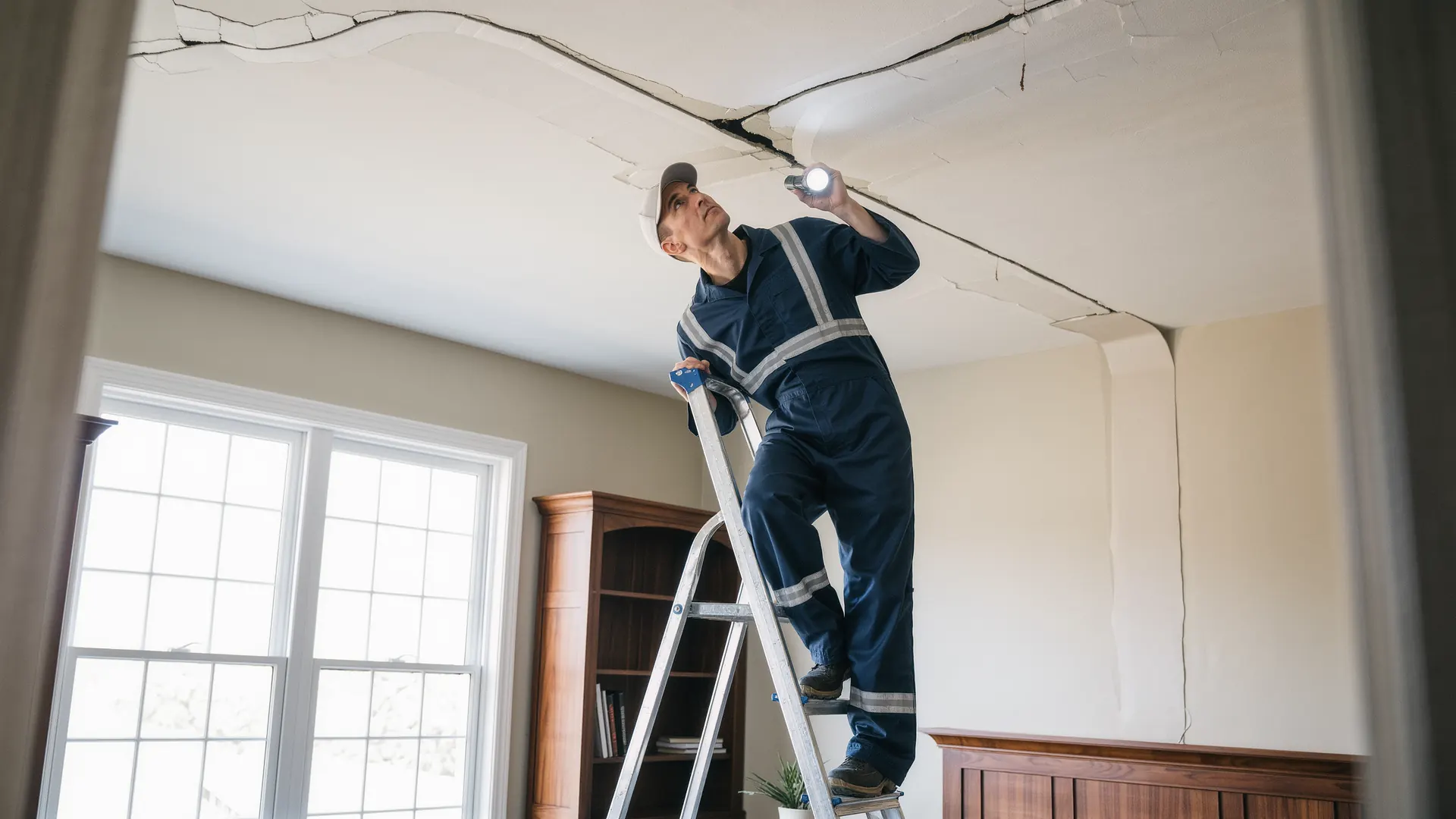
Straight crack along a seam
RoutineLikely cause: Truss uplift or a seam that was never taped properly. Common in 1980s and 1990s colonials in Fairfax and Loudoun where roof trusses move with seasonal humidity.
The fix: Re-tape with fiberglass mesh, three coats of compound, and in truss-uplift cases a floating corner so the ceiling can move without cracking again.
Brown or yellow ring stain
This weekLikely cause: A slow leak from above: a bathroom supply line, a roof nail pop, or an HVAC condensate line in the attic. The ring is the dried edge of the water.
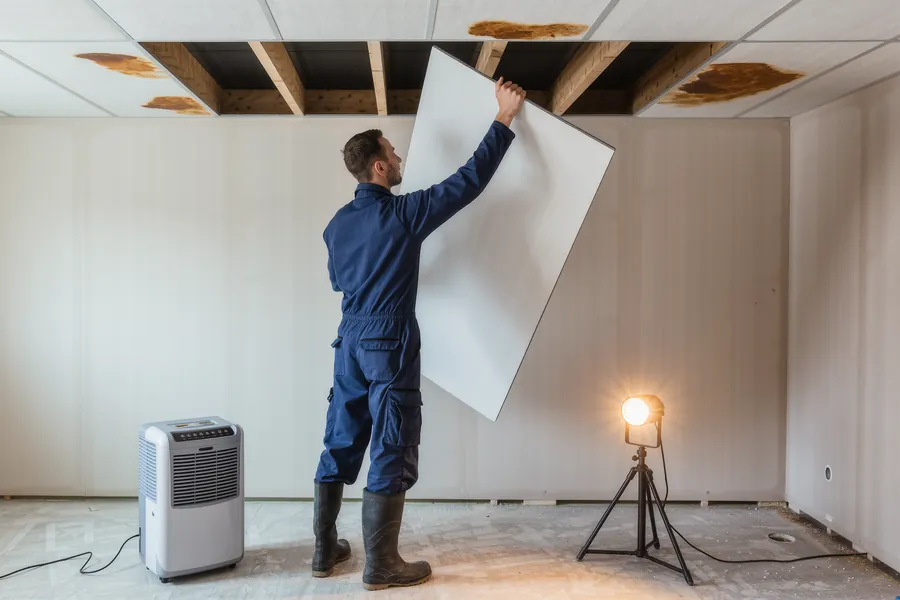
The fix: Find and stop the leak first. If the board is still firm, seal with a stain-blocking primer and repaint. If it is soft, cut it out and replace it.
Sag or bulge
TodayLikely cause: Saturated drywall, or screws that have pulled through the paper because the ceiling was hung with too few fasteners. Water-related sags can hold gallons.
The fix: Do not poke it. Clear the room, put a bucket under it, and call. We cut out the saturated section, dry the cavity, and rebuild it.
Popcorn texture flaking or dated
PlannedLikely cause: Age, humidity, or simply a finish nobody wants anymore. Pre-1980 texture may contain asbestos and must be tested before it is disturbed.
The fix: Test, then scrape and skim-coat to a smooth Level 5 finish, or cover with a new layer of 1/4-inch drywall when scraping is not an option.
Cracks radiating from a light fixture
RoutineLikely cause: Heat cycling and a cut-out that was never reinforced, or a fan that was mounted to the drywall instead of a brace.
The fix: Install a proper fan brace in the joist bay, patch the opening, and feather the repair out 12 to 18 inches so it disappears.
Why truss uplift shows up every winter
Many Northern Virginia homes have engineered roof trusses. In winter the bottom chord of the truss sits in warm, dry air from the house while the top chords sit in cold, damp attic air. The wood shrinks and swells unevenly, the truss arches slightly, and it lifts the ceiling drywall away from the interior walls. You see it as a crack where the ceiling meets the wall, often along a hallway, that opens in January and closes in July.
Filling that crack with compound every year does nothing, because the movement is structural and will return. The correct repair is to detach the ceiling drywall from the wall top plate near the joint and attach it to the wall drywall instead with a floating corner, so the ceiling can rise and fall without tearing the paint. It is a half-day job and it ends the annual crack for good.
What ceiling repair costs in Northern Virginia
Labor rates in Fairfax, Arlington and Alexandria run higher than the rest of our service area, and ceiling work takes longer than wall work because everything is overhead. As a guide for 2025:
- Seam or crack re-tape: $200 to $450 for a single room, including texture matching and primer.
- Stain seal and repaint: $150 to $300 once the leak is stopped.
- Water-damaged section replacement: $400 to $1,200 depending on size, plus insulation if the cavity got wet.
- Popcorn removal and smooth finish: $3 to $6 per square foot. A 12 by 14 bedroom lands around $500 to $1,000. Asbestos testing is extra and non-negotiable on pre-1980 texture.
- Fan brace and patch: $250 to $400 including the brace hardware.
Every number above comes from a written estimate before we start. If we open the ceiling and find more than expected, we stop and show you before the scope changes.
How we work on ceilings
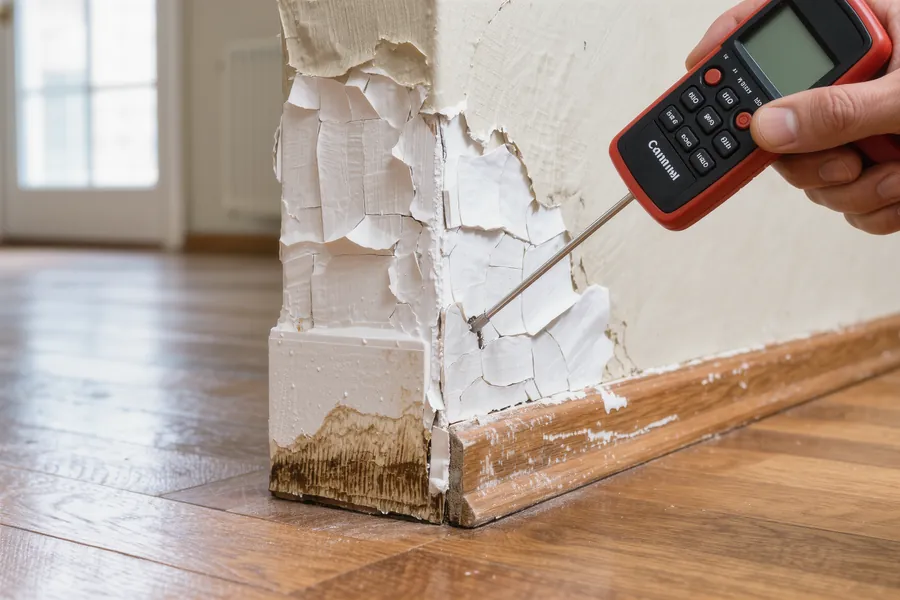
- Find the cause. A moisture meter on stains, a look in the attic for the truss and the leak, and a check of how the drywall was fastened.
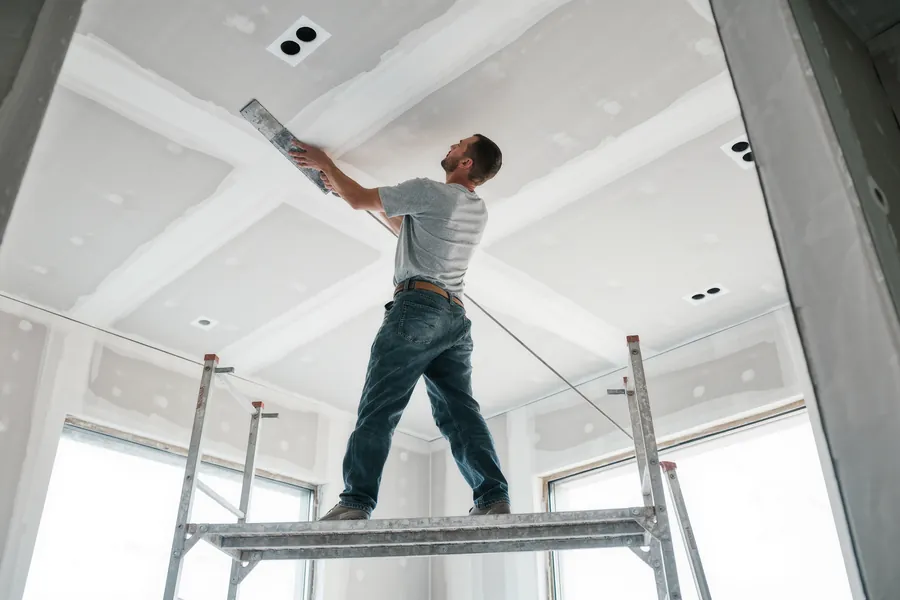
- Protect the room. Floors, furniture and door openings get covered. Overhead sanding makes more dust than wall work, so we use sanders with vacuum extraction.
- Repair properly. Mesh tape and setting compound on cracks, new board screwed on 12-inch centers for replacements, and a floating corner where trusses move.
- Match the finish. Knockdown, orange peel, smooth or stipple, matched to the rest of the ceiling so the patch does not show in raking light from a window.
- Prime and hand back. Stain-blocking primer on anything that was wet. You paint, or we do.
Ceiling repair across Northern Virginia
We are headquartered in Frederick, MD and typically reach Northern Virginia within 24 to 48 hours, same day for an active leak. Local pages for the communities we serve most often:
- Ceiling repair in Fairfax
- Ceiling repair in Arlington
- Ceiling repair in Alexandria
- Ceiling repair in Leesburg
- Ceiling repair in Sterling
- Ceiling repair in Ashburn
Related reading: water damage drywall repair, and our emergency response guide for what to do in the first hour when a ceiling is actively leaking.